

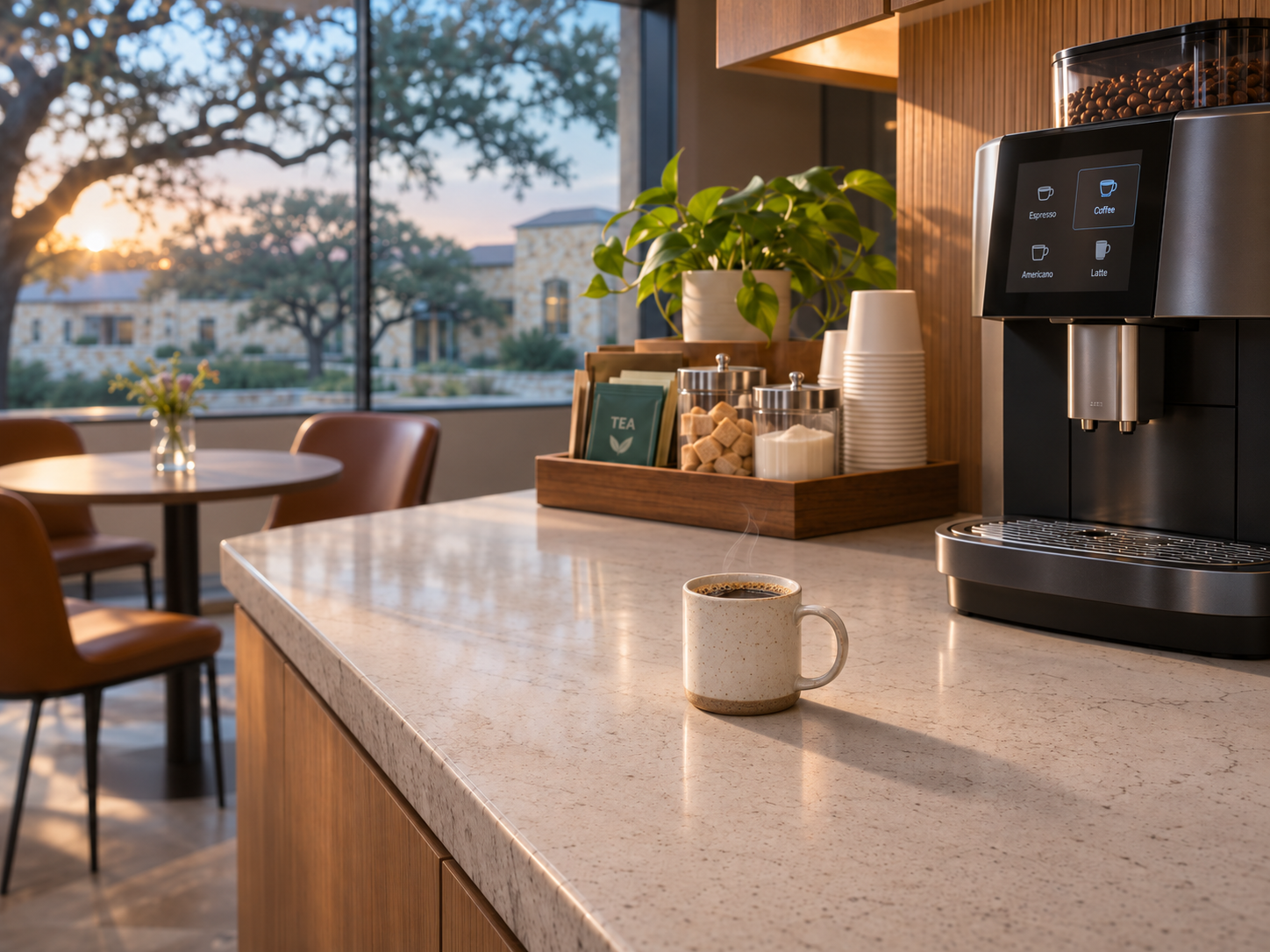
Office coffee service is often associated with large companies, but it fits a team of 10 as well as a team of 500. For a small office, it is one of the simplest amenities to add and one of the most used.
This post covers what San Antonio offices of 10 to 50 people can expect from a coffee service: what's included, how the program is matched to the team, how service works, what affects cost, and what to plan for.
Why coffee service suits a small office
Coffee is a daily habit for most of the workforce. In the National Coffee Association's Spring 2026 data, American coffee drinkers averaged 2.8 cups a day, and the workplace was the most common place people drank coffee outside the home. Tastes are also moving toward espresso-based drinks: 45% of adults had one in the past week, up from 40% in 2022.
Coffee service has no requirements for size, space, or shift structure, so a team of 12 gets the same program design and upkeep as a larger account. For a small office, that means a coffee setup sized to the team, with stocking and maintenance handled by the provider.
What's included
A full-service program for a small office typically covers four things:
Setup. We recommend the right setup for the space and the team, then install it.
Equipment. Brewers matched to the office's volume and drink preferences, at no cost for qualifying San Antonio offices.
Supplies. Gourmet coffee, tea, creamers, sweeteners, cups, and stirrers, delivered and stocked on a regular schedule.
Maintenance. Cleaning, descaling, and repairs on our route, so the equipment stays in working order.
Matching the program to a team of 10 to 50
Headcount sets the starting point, and the team's habits refine it.
Around 10 to 20 people. Single-cup brewing usually fits best. Each person picks their own coffee or tea, and nothing sits on a warmer through the afternoon.
Around 20 to 50 people. A mix often works well: a batch brewer for the morning rush, with single-cup or bean-to-cup equipment for variety through the day.
Espresso drinkers on the team. A bean-to-cup brewer grinds fresh for each cup and makes lattes, cappuccinos, and mochas at the push of a button. It suits offices toward the upper end of the range, where daily volume supports it.
These ranges are starting points. A 15-person office that runs on lattes and a 40-person office that drinks a pot of house blend each morning need different setups, and the site survey sorts that out.
How service works
Small offices are served on a regular route. Our team visits on a set schedule, restocks coffee and supplies, cleans the equipment, and checks that everything is working. Visit frequency is based on usage, so a 12-person office and a 45-person office each get a schedule that fits their consumption.
The selection adjusts over time. As the route shows what the office goes through quickly and what sits, we reweight the stock, and the team can request new options along the way. If something stops working between visits, a call to us gets a technician scheduled.
What drives cost
For most small offices, the ongoing cost is the coffee and supplies the team uses. A few variables shape that number:
Volume. Cups per day across the team, which follows headcount and attendance.
Drink mix. Espresso-based drinks and premium blends cost more per cup than a house drip.
Selection. The range of coffees, teas, creamers, and extras stocked.
Equipment. Brewers come at no cost for qualifying San Antonio offices. Qualification is based on expected volume and the program terms, and the site survey confirms it up front.
The survey ends with a proposal that spells out what is included, what the office pays for, and how the program is priced, so the monthly cost is clear before anything is installed.
What to plan for
The space requirements are modest:
Counter space for the brewer and a small supply station.
A nearby outlet. Some brewers also connect to a water line, while others run on a reservoir, and the survey determines which fits the room.
A little storage for backup supplies between visits.
Attendance matters as much as headcount. A hybrid office with 30 people on the roster and 10 in on a typical day uses far less than an office where all 30 come in daily. When an office's volume doesn't meet the threshold for no-cost equipment, we'll say so during the survey and recommend the most practical setup for how the team works.
Adding to the program as the team grows
Coffee is often the first piece of a broader breakroom plan. Small offices commonly add filtered water and chewable ice on the same service visits, and pantry service for snacks and drinks provided at no cost to the team and guests. As headcount grows, the same program scales: more equipment, a wider selection, or a second break area, with one provider and one point of contact throughout.
Getting started
A site survey takes little of your time. We look at the space, the team's size and attendance, and what people like to drink, then propose a program with clear terms. For a closer look at how to compare providers, see our guide to choosing an office coffee service, and for details on the program itself, visit our office coffee service page.
The survey is free. Call STX Vending at (210) 903-9363 or reach us through our contact page.