

Warehouses, distribution centers, and manufacturing plants run on a different set of conditions than an office. Shifts stretch across the day and night, crews spread over a large footprint, drivers and contractors move through, and work areas stay warm for much of the San Antonio year.
Those conditions decide which breakroom formats will work. This guide covers the options that fit industrial sites, the situations each one suits, and how facilities combine them into one plan.
What shapes an industrial breakroom
Five variables do most of the deciding at an industrial site:
Shift structure. One, two, or three shifts, and whether the building runs on weekends. Food access needs to hold up at 3 a.m. as well as at noon.
Location. Many facilities sit along the loops and highway corridors, a drive away from restaurants and stores. The farther the nearest option, the more the on-site breakroom carries.
Who is on-site. A stable workforce of regulars is a different population from one that includes drivers, temps, vendors, and visitors.
Environment. Dock areas, production floors, and unconditioned spaces call for formats built for heat, dust, and heavy traffic.
Space and security. Some sites have a large, secured breakroom. Others have a corner of the dock or a small room near the time clock.
Each format below fits a different combination of these conditions.
Vending: docks, overnight floors, and mixed traffic
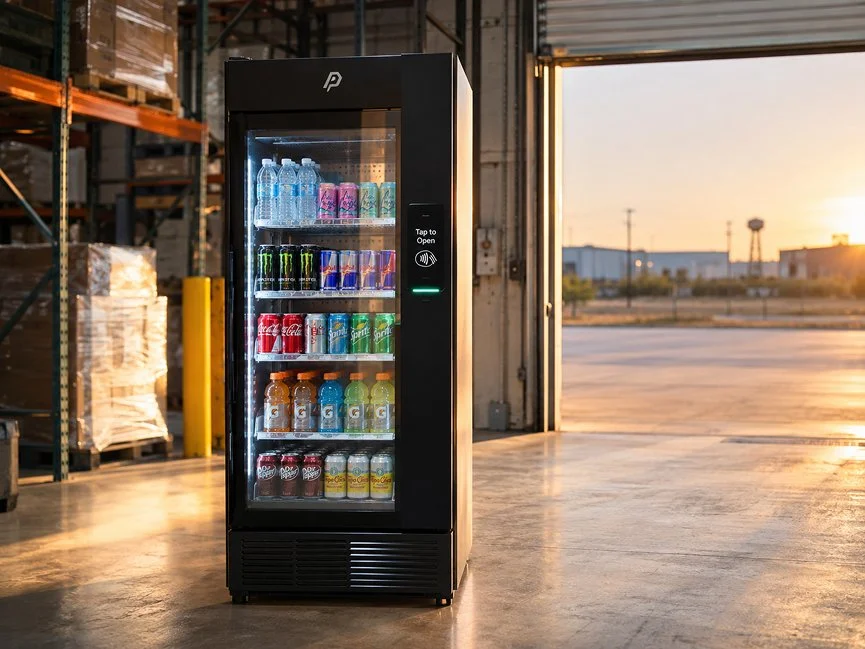
Vending fits the parts of a facility that see the widest mix of people and the longest hours. Because the format is closed and self-contained, it serves drivers, contractors, and visitors without supervision or loss exposure, and it runs every shift the same way.
It also performs in the spaces industrial sites tend to have: driver lounges, dock offices, and areas where floor space is tight and conditions are demanding. Placement requires no buildout. Where a facility has a single, secured workforce and room for something larger, the formats below usually serve the main breakroom better, with vending covering the satellite areas.
Smart coolers: fresh food for secured areas and smaller crews
Smart coolers sit between vending and a full market. They offer a self-serve selection with fresh food, salads, and sandwiches, and access can be limited to authorized users, which suits a secured production floor or a team breakroom behind the badge reader.
The footprint is small, so a cooler fits a satellite break area, a second building on the same campus, or a site whose headcount doesn't support a full market. Where mixed or public traffic shares the space, vending remains the better fit.
Micro markets and meal programs: the main breakroom at larger sites
A micro market is a full self-serve store on-site, and it fits facilities with a large, stable workforce, a secured breakroom used by the company's own team, and enough floor space to give it room. Where those conditions hold, it produces the highest daily engagement of any format and keeps more of the workforce on-site through breaks and meal periods.
A market also makes chef-crafted meals possible. Menus run to items like a breakfast sausage, egg, and country potato skillet for $4.75 at the start of an early shift, or blackened mahi mahi with cilantro lime rice, a side salad, chips, and a drink for $10. Many employers subsidize meals at a discount: at one of our San Antonio accounts, the average chef-crafted meal comes to $5.76 and employees rate the program 4.8 out of 5. A subsidized program can start as low as $0.30 per person per day, and the cost tracks the meals people buy.
A market requires the right conditions to succeed. Where the breakroom is shared with drivers and visitors, or the headcount is smaller, smart coolers and vending are the better match.
Coffee, filtered water, and chewable ice for every shift
Coffee service has no requirements for size, space, security, or shift structure, so it fits every industrial site and reaches nearly every role. A fresh cup at the start of a 5 a.m. shift or the middle of an overnight run is often the most-used amenity in the building.
Filtered water and chewable ice carry extra weight on warm floors and docks. OSHA's heat guidance for employers centers on water, rest, and shade, and recommends encouraging workers to drink water every 15 minutes in hot conditions. Dispensers and ice machines placed near the work areas, serviced on a set schedule, make that guidance practical to follow across every shift.
Combining formats across one facility
Most industrial sites use more than one format, because different parts of the building run on different conditions. A common layout for a multi-shift distribution center in San Antonio:
Main breakroom: a micro market with chef-crafted meals, or a smart cooler at a smaller site, plus coffee service.
Dock and driver areas: vending for mixed traffic and overnight access.
Production or warehouse floor: filtered water and chewable ice near the work zones.
Front office: coffee service and a water unit.
The right mix depends on the site. A smaller facility with one shift may be well served by coffee, water, and a cooler. A site without a secured breakroom may not be a fit for a market at all. We'll say which formats your building supports during the assessment and recommend accordingly, whether that is one format or several.
Getting started
A site assessment covers the whole facility. We look at shifts, headcount by area, who moves through the building, the environment on the floor and the dock, and the food options nearby, then propose the combination that covers all of it.
The assessment is free. Call STX Vending at (210) 903-9363 or reach us through our contact page, and we'll walk your San Antonio facility.